
MOTION TO DISMISS BASED ON INAUTHENTIC DISCOVERY EVIDENCE/
INAUTHENTIC EMAILS
Yes. The fraud gets worse.
After reviewing the submitted Email “Discovery” Evidence, which is also mentioned/partially quoted in the Arrest Warrant, I have found that the Email Discovery Evidence submitted is inauthentic.
What was handed over 45 days after Motion for Discovery is a pathetic attempt to doctor and hide information within an Email mentioned/partially quoted in Arrest Warrant at Section 14: Paragraph 4, and submitted as “Discovery Evidence”, all the while taking diabolical liberty to concoct lies and falsely accuse me in insane ways.
(Not to be confused with Arrest Warrant’s Section 14: Paragraph 6 that I shared in previous Motion to Dismiss on April 25, 2019 showing the omitted contents from a transposed and truncated text message masquerading as an Email.)
Corrupt Arrest Warrant
|
The Email on Sept. 15, 2018 at 6:35 pm
is missing/omitting contents.
Yes. There is a .… (dot dot dot)
This …. (dot dot dot) was not part of the Email.
This Email is copied and printed as if they are emanating directly from the Internet source and appear like ALL the authentic Emails I have printed, but in actuality Discovery submitted are inauthentic Emails.
What has been handed over are doctored Emails that are omitting the contents of the relative Email.
They are frauds.
Yes. Inauthentic Emails.
ALL the many Emails (plural) or Email chain of Sept 15, 2018 (and not merely the lone and doctored Email off Sept. 15, 2018 that was pathetically handed over by D.A. Justina Lynn Moore at the 45-day deadline) are very significant. The chain of Sept. 15, 2018 Emails are the source of the disagreement between Complainant and I that triggered this sick small-soul Complainant to feign as if she is a victim. The Sept. 15, 2018 multiple Email chain of communication would be inevitably shared by me in Due Process. Yet since the one Sept. 15, 2018 Email that was mentioned in the Arrest Warrant and shared as “Discovery Evidence” is a fraud aka inauthentic, I now once again move that this insane case be immediately dismissed.
In the cowardly inauthentic Email “Discovery” evidence this is what is shared –
Sept. 15, 2018 at 6:35 pm
“CRYSTAL ....
THIS COULD HAVE WAITED.
AND YOU COULD HAVE TOLD ME ABOUT THE FUCKING "POLICEMAN" WHEN IT HAPPENED.
I DO NOT KNOW WHAT TO BELIEVE WITH YOU.”
(end doctored inauthentic email)
INAUTHENTIC EMAIL - See Pathetic "Discovery" by the Corrupt Officer Mark Grasso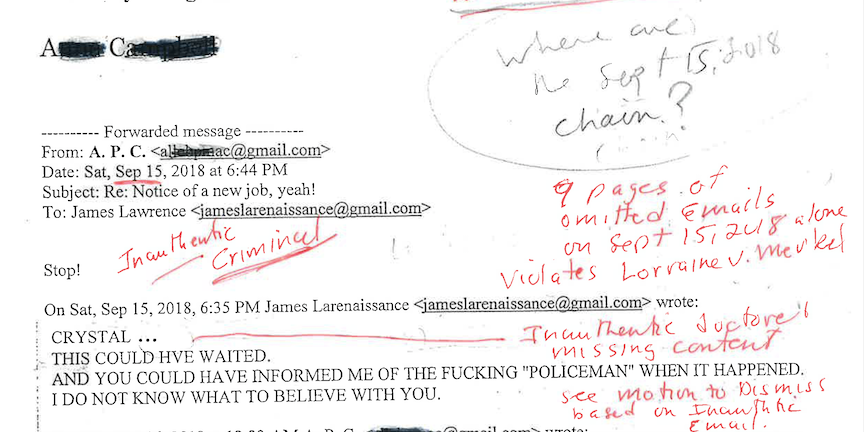
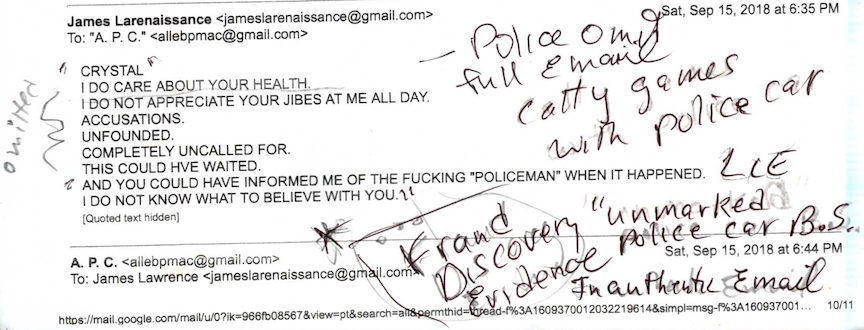
The actual Email is the following – (green being the omitted material).
Sept. 15, 2018 at 6:35 pm
“CRYSTAL
I DO CARE ABOUT YOUR HEALTH.
I DO NOT APPRECIATE THE JIIBES AT ME ALL DAY.
ACCUSATIONS.
UNFOUNDED.
COMPLETELY UNCALLED FOR.
THIS COULD HAVE WAITED.
AND YOU COULD HAVE TOLD ME ABOUT THE FUCKING "POLICEMAN" WHEN IT HAPPENED.
I DO NOT KNOW WHAT TO BELIEVE WITH YOU.”
(end authentic email)
(SEE ATTACHMENT OF AUTHENTIC EMAIL)
Yes – Yet another ...... (dot dot dot) hiding/concealing material,
a doctored inauthentic Email that is attempted to be passed-off as an authentic Email communication and unlawfully submitted as Discovery Evidence.
SO
WHAT IS MISSING IN THE INAUTHENTIC EMAIL PRESENTED AS “DISCOVERY”?
I DO CARE ABOUT YOUR HEALTH.
AND WHAT ARE THESE STATEMENTS?
I DO NOT APPRECIATE THE JIIBES AT ME ALL DAY.
ACCUSATIONS.
UNFOUNDED.
COMPLETELY UNCALLED FOR.
LET ALONE, WHERE IS ALL THE PREVIOUS AND ESSENTIAL CHAIN OF EMAILS OF THAT TIME AND THAT DAY?
ALL THE EVIDENCE OF THE NUMEORUS FALSE ACCUSATIONS AND FALSE STATEMENTS/PERJURY BY COMPLAINANT, EXIST WITHIN ALL THE EMAILS.
THIS ...... (dot dot dot) EMAIL WAS SHARED IN THIS SAME CONCEALING FORM WITHIN ARREST WARRANT, AND GIVEN IN THE INAUTHENTIC WAY AS DISCOVERY. It is essential to be authentic because it is presented as some kind of proof of ending communication with me/the accused, despite the facts of her holding belongings of mine hostage and being receptive to allowing me to show my apartment to prospective tenants.
AUTHENTIC EMAIL
 |
Yes Your Honor. You have been and are being played with, and should be as outraged as I am. Complainant and the Police are making a mockery of the court. What the Police handed over at the 45-day deadline was fraudulent inauthentic Emails. These Emails submitted are not emanating straight from the Internet. This is not proper legal Discovery. This is a cover up. This is once again an attempt to conceal important and significant information that show the wicked state of mind of Complainant on the day before I arrived (on Sept. 16, 2018), which is one day after the doctored Sept. 15, 2018 Email, and the wicked state of mind of Complainant when she involved police Sept. 17, 2018. My next Email to her was a one sentence Email on Sept. 18, 2018 merely looking out for the welfare of my parents –
Quote: “Ana Advice. Do not cause my beloved 77-year old parents any stress whatsoever. Take this Advice.”
This submitted faux/fraudulent Sept. 15, 2018 Email missing the entire contents, and omitting the proper needed chain of Emails that establish the context of the communication, was amongst a concerted wicked attempt to get me arrested without any proper convictable evidence of “harassment” of any kind (see also Previous Motion to Dismiss based on Transposed and Truncated/Omitted Text Message within Arrest Warrant at Section 14: Paragraph 6). Complainant knew what she was doing. She attempted to cry wolf when there was no wolf. What we have here is concealed material that would show the crazy state of mind of the Complainant and incriminate her for giving False Statements/Perjury. This woman belongs behind bars.
These inauthentic Emails are not only a gross violation of Discovery deadlines graciously given by the Judge, but also gross violations of codes of conduct and laws in general. Given the multiple deadlines violated, wasted time, wasted monies, and yet again slander from the Westport News that I need to clean up from this fabricated ordeal and resulting false arrest, etc… of this obvious deceit attempted to be passed off as legal authentic completed “Discovery Evidence” of harassment, I ask for JUSTICE and that this case be dismissed so I can return to my business and home abroad without further delays. These delays will only inevitably end in me presenting all the overwhelming types of evidence LET ALONE authentic Email evidence before good people to be found NOT GUILTY, resulting in more litigation based on the damages I have experienced from this ordeal.
Since I have a Franks Hearing scheduled May 14th, and this gross misconduct in the form of inauthentic Emails has been submitted, the time has come to end this fiasco for there will never be proper handovers of effective Discovery Evidence for me to pursue my Franks Hearing in a fair and timely fashion (like also the omitted videos – see Motion to Compel Omitted Basic Audio and Video Discovery for May 2nd Motion docket as well). The Police have had their multiple chances to submit authentic Emails and it is not the court’s job to instruct and guide the police anymore on what is essential Discovery like authentic Emails. All of these highly questionable blunders would inevitably be shared in a trial. Once again, this material that was attempted to be passed-off as “Discovery Evidence”, was allegedly started back in September of 2018 – 8 months ago! And we are now nearly 90 days and 4+ deadlines since my Feb. 15, 2019 Motion for Discovery Evidence. Nothing is going to change and nothing should be allowed to change given the disrespect for obeying proper police procedures, Due Process of Law, and repeated deceptions by Complainant.
I am an honest man and so I will state the following so it is clear that I fully intend to protect myself in every way, given the out of ordinary happenings in this false arrest and legal process. Every single appearance, Motion filed, unnecessary pain and sufferings, etc… have been, and are being accumulated, documented, and recorded if the need to share with proper people who have the power to investigate this further and protect me comes about.
MEN HAVE RIGHTS AND DESERVE TO BE PROTECTED TOO!
FEDERAL RULES OF EVIDENCE RULE 901– authenticating and identifying evidence.
Because of the spontaneity and informality of e-mails, courts seem to think people are “more themselves” for better or worse, than other deliberative forms of written communication.36 Thus, e-mail evidence often figures prominently in cases where state of mind, motive and intent must be proved.37 E-mails are often authenticated under Rules 901(b)(1) (person with personal knowledge), 901(b)(3) (expert testimony or comparison with authenticated exemplar), 901(b)(4) (distinctive characteristics, including circumstantial evidence), 902(7) (trade inscriptions), and 902(11) (certified copies of business record).38
In Lorraine v. Markel American Insurance Co ., 241 F.R.D. 534 (D. Md. 2007), United States Magistrate Judge Paul W. Grimm refused to allow either party to offer emails in evidence to support their summary judgment motions, finding that they failed to meet any of the standards for admission under the Federal Rules of Evidence. The emails were not authenticated but simply attached to the parties' motions as exhibits, as has become common practice. Magistrate Judge Grimm opined: "If it is critical to the success of your case to admit into evidence computer stored records, it would be prudent to plan to authenticate the record by the most rigorous standard that may be applied."
As a result, now more than ever, organizations have a much greater obligation to ensure that their electronic records are secured in their original state without alteration. Courts are requiring organizations to prove, irrefutably, that their electronic evidence - including trade secrets, legal documents, accounting records, emails, IM logs and image files - and its associated metadata were never deleted or altered any time during the life of the document. The problem is that electronic records, including imaged files, can be easily deleted, altered or manipulated by anyone with motivation and minimal tech-savvy.
Rule 34 governs requests for production of documents. Under the amendments, parties are required to address the issue of the form in which ESI will be produced (e.g., TIFF, PDF, native, etc.). The requesting party has the option to specify a preferred form, and gives the producing party the option to object to the requested form and suggest its own preference. In the event of a dispute, the court will be required to resolve it. Interestingly, the new amendments provide that if the requesting party does not specify the form for producing ESI, it is incumbent upon the responding party to produce the information in a form or forms which are "reasonably usable" or in which the information is "ordinarily maintained." "Ordinarily maintained" generally means in its "native" format.
Most e-mail systems, for instance, allow a person forwarding an e-mail to edit the message being forwarded. Such alteration wouldn’t be discernible to the recipient. E-mails are also more prone to a kind of hearsay-within-hearsay problem: an “e-mail chain” attaches to an e-mail every e-mail that came before it in a discussion. It isn’t enough to get the most recent e-mail into evidence when that e-mail attaches a string of previous e-mails.
A ‘thread of emails” was mentioned in Discovery yet not provided to me James Lawrence.
WHERE IS THE THREAD OF EMAILS LET ALONE AUTHENTIC EMAIL THAT DOES NOT DOCTOR THE CONTENT IN SELF-SERVING WAYS.
All of the prior e-mails may need to be separately authenticated and found admissible. An e-mail often has attached to it the e-mail or series of e-mails to which it is responding, creating an e-mail “chain,” also known as a “string” or “thread.” Some courts have found that each e-mail in a chain is a separate communication, subject to separate authentication and admissibility requirements. A lawyer should thus be prepared to authenticate every step of a chain.
Authentication becomes a critical issue when dealing with native electronic records. Whenever a native file is opened, the metadata associated with that record changes to reflect the time that file was opened and by whom. Technically, the file was altered, resulting in a chain of custody issues. Based on the Federal Rules of Evidence, companies must be able to prove that throughout a record's chain of custody, its intended content and metadata are pristine. If they are unable to do this, the file may not be legally admissible.
What is one to do to try to get an E-mail into evidence when it is necessary to get all the other prior e-mails to be separately authenticated and found admissible?
Trusted time-stamping cryptographically seals native electronic records, proving to all stakeholders, even during the e-discovery and review process, that the file and its metadata were never altered, even when opened. An external or trusted time-stamp is a data-level security control that enables organizations to unquestionably prove the authenticity of their electronic records.
A U.S. District Court for the Southern District of New York decision granting terminating sanctions against plaintiff after finding by clear and convincing evidence that its president had willfully fabricated emails in the course of discovery and then deleted the native versions to conceal his fraud.
Rule 902. Evidence That Is Self-Authenticating
((14) Certified Data Copied from an Electronic Device, Storage Medium, or File. Data copied from an electronic device, storage medium, or file, if authenticated by a process of digital identification, as shown by a certification of a qualified person that complies with the certification requirements of Rule (902(11) or (12). The proponent also must meet the notice requirements of Rule 902 (11).
The Lorraine court suggested any electronic document can be authenticated under 901(b)(4) using metadata. Metadata is “data about data.” See Netword LLC v. Centraal Corp., 242 F.3d 1347, 1354 (Fed. Cir. 2001); see also Fed. R. Civ. P. 26(p) Advisory Committee Note (describing metadata); THE SEDONA GUIDELINES: BEST PRACTICE GUIDELINES AND COMMENTARY FOR MANAGING INFORMATION AND RECORDS IN THE ELECTRONIC AGE. “Because metadata shows the date, time, and identity of the creator of an electronic record, as well as all changes made to it, metadata is a distinctive characteristic of all ESI that can be used to authenticate it under Rule 901(b)(4).” Lorraine, 241 F.R.D. at 547-48. Again, pretrial discovery of metadata can be crucial to ensure important ESI gets into evidence.
THUS
The INTENT of the Complainant is within all forms of communication under the statue of Second Degree Harassment that include third party text messages. In this case – Emails and YES texts messages especially text messages mentioned and partially quoted in the Arrest Warrant are to be compelled as Discovery evidence.
AUTHENTIC EMAILS REPRESENT AN ALLEGED CHAIN OR STRING OR THREAD OF EMAILS/COMMUNICATION.THESE NECESSARY THREADS/CHAINS/STRINGS OF EMAILS ARE COMPELLED BECAUSE TEY PROVIDE NECESSARY STATE OF MIND. THERE ARE NO SUCH THREADS/CHAINS/STRINGS OF EMAILS THAT WERE HANDED OVER IN DISCOVERY PROCESS.
FACT: THER ARE OVER $) EMAILS JUST FROM SEPT. 15, 2018 WITH COMPLAINANT.
FACT: YOU CANNOT SUBMIT A DOCTORED EMAIL THAT OMITS THE ENTIRE CONTENTS OF THE RELATVIE EMAIL/EMAILS SHARED.
DISCOVERY SUBMITTED TO ME JAMES LAWRENCE HAS INAUTHENTIC EMAILS ESPECIALLY THE ONE SHARED THAT IS ALLEGEDLY PART OF “HARASSMENT”. JUST UTTER NONSENSE.
The court cited to Lorraine v. Markel Am. Ins. Co., a Maryland federal case, for the proposition that e-mail messages may be authenticated by either (1) direct evidence or (2) circumstantial evidence.
Authentication By Direct Evidence
An e-mail could be authenticated by direct evidence alone if its author or proponent testifies to producing the contents of the email. An e-mail may also be authenticated by direct evidence when someone with personal knowledge of the email, such as someone who helped write or edit it, attests to its authenticity. Authentication by direct evidence is conclusive in itself, but sometimes it is only possible to establish the authenticity of one side of the communication.
In the case of Mr. Donati, the police officers were each able to attest to the authenticity of their own responses to Mr. Donati’s e-mails, but nobody could directly attest to the authenticity of the e-mails allegedly written by Mr. Donati, especially since Mr. Donati denied he was their author. That’s the problem here, right? The authenticity of Mr. Donati’s side of the communication, which was obviously essential to upholding his conviction for e-mail harassment, could only be established through circumstantial evidence.
Authentication By Circumstantial Evidence
When direct evidence is unavailable to establish authenticity of an email, circumstantial evidence may be used. Examples of circumstantial evidence that may be used by the court in authenticating emails include the sender’s IP address, the contents of the e-mail (i.e. do they contain information that only the alleged sender would possess?), the use of names or nicknames, and any other identifying factors that could link an e-mail address to a certain person as its sender or author.
The piece of circumstantial evidence that doomed the Defendant and authenticated the e-mails as being written by him was the paper found in his house with the various email addresses recorded on it, some of which were used to communicate lies to the police and threats to the bar owner. When coupled with the fact that the e-mails all covered the same subject matter, were written in the same tone, written during the same time period, and the fact that Mr. Donati often followed up his e-mails with phone calls, all circumstantially authenticated the e-mails in the eyes of the court as being authored by Mr. Donati. Combined with the direct evidence provided by the police officers as to the authenticity of their half of the electronic communications, the court found sufficient grounds to uphold the authentication of the e-mails by the trial court.
Rule 901(a) [11] - This rule points out that one has to be able to prove that the ESI present is indeed what one claims it to be. The methods that can be used for authenticating evidence are described in the rule. Specifically for ESI, creating hash values or analyzing meta-data are both generally accepted methods.
In the case of Lorraine v. Markel, neither plaintiffs nor defendants authenticated the exhibits attached to their motions, rendering them useless as evidence. This was also the first reason for dismissing the motions.
In the case of Lorraine v. Markel, neither plaintiffs nor defendants authenticated the exhibits attached to their motions, rendering them useless as evidence. This was also the first reason for dismissing the motions
Rule 801[12] - Evidence is hearsay if it constitutes a statement offered for its substantive truth and is not excluded from the definition of hearsay, unless it is an exception under rules 803,[13] 804[14] or 807.[15]
Rules 1001 - 1008[16][17][18][19][20][21][22][23][24] - This set of rules defines that the evidence provided should either be original or an admissible duplicate, and if that is not possible which secondary evidence could be admissible instead in order to prove the contents of the evidence. Examples hereof often used for ESI are summaries or photographs of the original evidence.
Rule 901(a) [11] - This rule points out that one has to be able to prove that the ESI present is indeed what one claims it to be. The methods that can be used for authenticating evidence are described in the rule. Specifically for ESI, creating hash values or analyzing meta-data are both generally accepted methods.
In the case of Lorraine v. Markel, neither plaintiffs nor defendants authenticated the exhibits attached to their motions, rendering them useless as evidence. This was also the first reason for dismissing the motions.
See also United States v. Tank on admissibility of chat room logs
Rules 1001 - 1008[16][17][18][19][20][21][22][23][24] - This set of rules defines that the evidence provided should either be original or an admissible duplicate, and if that is not possible which secondary evidence could be admissible instead in order to prove the contents of the evidence. Examples hereof often used for ESI are summaries or photographs of the original evidence.
Rule 403[25] - This rule is the final rule that can still result in dismissal of evidence. It stipulates that even though the presented evidence has probative value, it may still be deemed not admissible if its admission would create unfair prejudice, confuse or mislead the jury or delay the trial unnecessarily. With regards to ESI, examples of evidence that could be dismissed under this rule are when the evidence contains excessive offensive language, or when computer animations are used to make a point which can be incorrectly interpreted by the jury.
I also wish to share the following common sense reason for dismissal of this case. Given the pathetic Discovery evidence, only the question of “alarm” could be attempted to be at hand. Read the statute for Second Degree Harassment, and compare to the lack of repeated Emails, and language of my Email/s that show there was no harassment at all. Someone held my belongings hostage and I am the co-landlord of the place.
Sec. 53a-183.Harassment in the second degree: Class C misdemeanor. (a) A person is guilty of harassment in the second degree when: (1) By telephone, he addresses another in or uses indecent or obscene language; or (2) with intent to harass, annoy or alarm another person, he communicates with a person by telegraph or mail, by electronically transmitting a facsimile through connection with a telephone network, by computer network, as defined in section 53a-250, or by any other form of written communication, in a manner likely to cause annoyance or alarm; or (3) with intent to harass, annoy or alarm another person, he makes a telephone call, whether or not a conversation ensues, in a manner likely to cause annoyance or alarm.
One again – this is the Email mentioned within the Arrest Warrant and submitted as Discovery.
Quote: “Ana Advice. Do not cause my beloved 77-year old parents any stress whatsoever. Take this Advice.”
English: Advice - guidance or recommendations offered with regard to prudent future action.
THIS “recommendations offered with regard to prudent future action”
IS NOT ALARM as mentioned in the statute.
English: Prudent - wise or judicious in practical affairs; sagacious; discreet or circumspect; sober.
English: Alarm – a warning of danger.
The Email is a call for prudence.
THERE IS NO THREAT NOR IS THERE ANY WARNING OF DANGER.
Especially since my ultimatum had to do with me visiting the police to make a complaint about Complainant, an attempted complaint from me to police that is documented within the Police Reports and on tapes yet outrageously kept out of the Arrest Warrant.
AND there is no repeated, persistent, nor multiple Emails that most often are part of a typical Email harassment case. What we have here is an opportunistic attempt to get me arrested.